

Long before anyone was carving crystal skulls in Brazil, the idea of them already had a strong hold on people. A clear quartz skull, the size of a real one, said to be thousands of years old and able to hold memory, sing, heal, or show the future — that’s the kind of story that stays with you. I’ve spent a long time around crystal skulls, and I still understand exactly why these legends pull people in.
This guide walks through the most famous crystal skulls — the Mitchell-Hedges skull, Sha Na Ra, and Max — and the old legend of the thirteen skulls that ties them together. I’ll tell the stories the way they’re told, but I’ll also be straight with you about what the research actually shows. The truth turns out to be more interesting than the myth, not less. And at the end, I’ll explain where the skulls people actually own today come from, and how they connect back to all of this.
The Short Version
If you only want the gist: the famous crystal skulls — the Mitchell-Hedges skull, Sha Na Ra, Max — are real quartz carvings with powerful modern legends attached. What’s disputed is their age. The museum skulls that have been studied closely, and the Mitchell-Hedges skull, point to modern carving rather than ancient Maya or Aztec work. A few privately held skulls sit in murkier territory, leaning on their keepers’ accounts. None of that has made them matter less: these are the skulls that built the modern fascination with crystal skulls, and led a lot of people to the hand-carved quartz skulls being made today. The rest of this page is the longer, more interesting story.
The Mitchell-Hedges Crystal Skull
If you’ve heard of one crystal skull, it’s almost certainly this one. The Mitchell-Hedges skull is a life-size human skull carved from a single piece of clear quartz, with a detachable lower jaw — a detail that sets it apart from nearly every other skull. It weighs a little under twelve pounds, and the carving is beautiful: clean and anatomically convincing in a way that has unsettled people for decades.
The story most people know goes like this. In 1924, during an expedition led by the British adventurer F.A. Mitchell-Hedges to the ruined Maya city of Lubaantun in what’s now Belize, his adopted daughter Anna found the skull under a collapsed altar on her seventeenth birthday — and the detachable jaw turned up nearby a few months later. Mitchell-Hedges took to calling it the “Skull of Doom,” and Anna later said the remaining Maya had told her it was used by a high priest to will death on his enemies. It went on to help inspire the crystal skull in the Indiana Jones films.
It’s a wonderful story. The problem is that the records don’t support it. Mitchell-Hedges never mentioned finding a crystal skull in his own writings about Lubaantun, and others present at the dig recorded neither the skull’s discovery nor Anna being there. What researchers did find was a paper trail: the skull surfaces in London in the 1930s in the hands of an art dealer named Sydney Burney, and Mitchell-Hedges bought it at a Sotheby’s auction in 1943. When the Smithsonian examined it, they found it nearly identical to another famous piece — the British Museum’s crystal skull — and the analysis showed it had been carved and polished with modern, high-speed, diamond-tipped rotary tools, not anything available to the ancient Maya.
Anna kept faith in the skull’s story until she died in 2007, at a hundred years old; it’s now in the care of Bill Homann, who still believes in it. None of the science has dimmed its fame, and I don’t think it should. It’s a remarkable object with a real hold on people. It just isn’t the ancient relic the legend made it out to be.

Sha Na Ra & Nick Nocerino
If the Mitchell-Hedges skull is the most famous, Sha Na Ra is the one most tied to the serious study of crystal skulls — because of the man who found it. F.R. “Nick” Nocerino spent most of his life researching these objects, and many people in the field consider him the grandfather of crystal skull research. He founded the Society of Crystal Skulls International in 1945, held one of the first parapsychology teaching credentials issued in California, and co-authored one of the foundational books on the subject, Mysteries of the Crystal Skulls Revealed.
Nocerino said he located Sha Na Ra in the 1990s using “psychic archaeology” — pinpointing a site through intuition and remote viewing rather than maps. The search led a dig in Guerrero, in southern Mexico, where the skull was recovered along with others. He named it after one of his guides. Sha Na Ra is clear quartz, around fourteen pounds. Since his death in 2004, his daughter Michele Nocerino has cared for the skull and carried on his work.
Nocerino is also a big part of why the legend of the thirteen crystal skulls is so widely known today — though, as I’ll come to, that story is older than he was. He believed the skulls were connected across the world, with one master skull holding the knowledge of all the others.
It’s worth being honest about the testing, because you’ll see strong claims on both sides. In 1996 the British Museum, working with the BBC, examined several skulls under an electron microscope — Sha Na Ra and Max among them — and the museum’s own skull and the Smithsonian’s were shown to carry modern tool marks. Sha Na Ra’s caretakers say the testing didn’t find the same kind of marks on it, and they take that as support for an ancient origin. Mainstream archaeology hasn’t accepted that as proof. It’s worth being clear about where the firm evidence sits: the museum skulls and the Mitchell-Hedges skull have been studied in real detail and point to modern carving, while privately held skulls like Sha Na Ra and Max rest more on caretaker accounts and documentary testing than on peer-reviewed study. I’ll let that sit where it sits. What isn’t in dispute is that Nocerino took these objects seriously and studied them more carefully than almost anyone.

Max the Crystal Skull
Max is the giant of the group. At around eighteen pounds of clear quartz, it’s the largest of the famous skulls, and its keeper, JoAnn Parks of Houston, tours with it so widely that a lot of people in the crystal world have sat with Max in person. That accessibility is a big part of why it’s so well known — where the Mitchell-Hedges skull stays under its caretaker’s careful guard, Max travels to shops and gatherings and lets people get close.
The story told about Max is that it was found in a tomb in Guatemala in the 1920s, passed from a Maya shaman to a Tibetan-trained healer, and eventually given to the Parks family in the 1970s. JoAnn says she kept it boxed in a closet for years before it, in her words, made itself known and told her its name. Believers put its age anywhere from a few thousand to tens of thousands of years.
Like the others, Max was part of the 1996 round of British Museum testing, and like the others, the ancient-origin claim sits in contested territory. What’s not in question is that Max has a presence people respond to, and a white “cap” of natural matrix on its crown that Nocerino thought helped it work like an amplifier.
The Famous Skulls at a Glance
| Skull | Material | Claimed origin | What the evidence suggests | Why it matters |
|---|---|---|---|---|
| Mitchell-Hedges | Clear quartz, detachable jaw | Lubaantun, Belize (1924) | Provenance traces to a 1943 auction; lab analysis points to modern carving | The most famous skull of all |
| Sha Na Ra | Clear quartz | Guerrero, Mexico | Contested; rests largely on private and documentary claims | Tied to researcher Nick Nocerino |
| Max | Clear quartz | Guatemala | Contested; rests largely on caretaker accounts | Widely toured and experienced in person |
| British Museum skull | Clear quartz | Claimed Aztec / Mexico | Most likely 19th-century European | The key studied museum example |
The Legend of the Thirteen Crystal Skulls
Underneath all these individual stories runs one bigger legend, and it’s the one that gives the whole subject its pull: the legend of the thirteen crystal skulls.
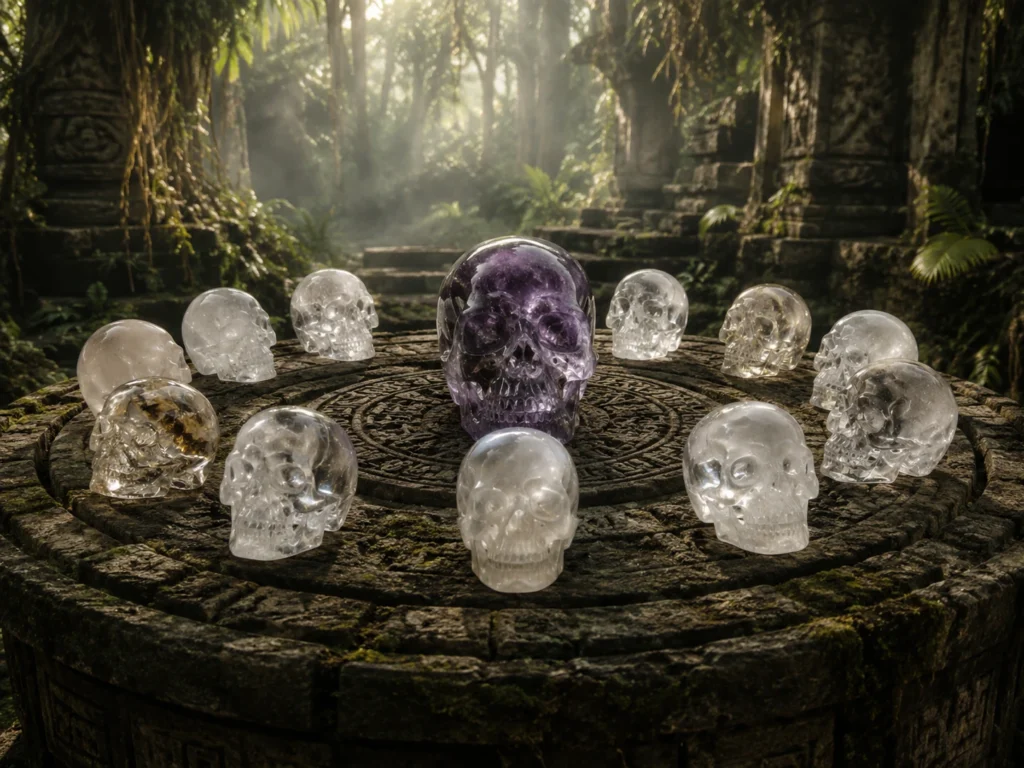
The version most people know comes through Native American teaching, recorded in the early 1990s by the writer Kenneth Meadows from the Cherokee teacher Harley Swiftdeer. As the story goes, there are twelve crystal skulls, each carved from a single piece of quartz and each the size of a human head, with jaws that move and can “sing” or “speak.” They were kept in a circle around a thirteenth master skull — an amethyst one — and together they held the knowledge of human origins, purpose, and destiny, like thirteen living libraries. One day, when humanity is ready and won’t misuse what they hold, the skulls are meant to be reunited and made whole again.
It’s a beautiful idea, and it’s worth saying plainly that it’s a modern one. As researchers have pointed out, this legend doesn’t actually appear in genuine Mesoamerican or Native American mythology in the form it’s usually told — it took shape in the twentieth century, and Nick Nocerino did a lot to carry it into the wider crystal community. You’ll also find people who count thirty-six skulls, or fifty-two, rather than thirteen. Like a lot of oral tradition, it shifts in the telling.
None of that has to spoil it. A story doesn’t need to be ancient to mean something. The thirteen-skulls legend has become its own kind of modern myth, and the fascination it carries is real even where the history is thin.
Are Crystal Skulls Real?
This is one of the most common things people type into a search bar, and the honest answer depends on what you’re really asking.
If you mean “is it real quartz, a real carved object?” — then yes, absolutely. The famous skulls are solid, single pieces of genuine rock crystal, and many of them are extraordinary carvings. There’s nothing fake about the stone or the craftsmanship.
If you mean “are they genuinely ancient, carved by the Maya or Aztec thousands of years ago?” — that’s where it gets contested. The major museum skulls that have been studied closely — along with the Mitchell-Hedges skull — show signs of modern carving: the regular marks left by rotary cutting wheels and hard abrasives that didn’t exist in the pre-Columbian Americas. On that evidence, mainstream researchers regard those “ancient” skulls as nineteenth- or twentieth-century work. For privately held skulls like Sha Na Ra and Max, the picture is harder to judge from the outside, because most of what circulates comes from caretakers, documentaries, and crystal-skull circles rather than peer-reviewed archaeology. Their keepers point to testing they say came back clean; mainstream archaeology hasn’t accepted that as settled, and probably never will to everyone’s satisfaction.
My own view is that you don’t have to land this question to find the skulls worth caring about — and you’re entitled to your own. Plenty of people feel a real connection to these objects regardless of when they were made. What I’d gently steer you away from is paying ancient-relic money for an ancient-relic claim that can’t be backed up.
A Short History of Crystal Skulls
So if the famous skulls aren’t pre-Columbian, where did they actually come from? The trail is well documented, and it’s a good story in its own right.
Most of the famous skulls can be traced back to one man: Eugène Boban, a French antiquities dealer who worked in Mexico City in the mid-1800s and later sold from shops in Paris and New York. Boban dealt in real pre-Columbian artifacts and in fakes, and he sold crystal skulls as ancient Aztec treasures at exactly the moment when Europe and America were hungry for that kind of mystery. The British Museum’s skull passed out of his world through Tiffany & Co. before the museum bought it in 1897; today the museum itself labels it as probably nineteenth-century European, not an authentic pre-Columbian piece.
Where were they actually cut? Most likely in Idar-Oberstein, a town in Germany that was the great lapidary center of the age. And here’s the detail I keep coming back to: Idar-Oberstein’s carvers worked largely from quartz shipped in from Brazil. When researchers analyzed the tiny inclusions inside the famous skulls, the stone matched Brazil or Madagascar — not Mexico at all.
It’s worth remembering that skull imagery itself is deeply real in Mesoamerica — the Aztec and Maya carved skulls in stone and built whole racks of them at their temples. But carved quartz skulls aren’t part of that record; not one has ever turned up in a documented excavation. The skull as a sacred shape is genuinely ancient. The clear-quartz crystal skull, as we know it, is a more recent creation — and very often a Brazilian-stone one.
From Legend to Today: Hand-Carved Skulls from Brazil
I find that last detail quietly fitting, because it’s close to where my own work begins.
The famous skulls weren’t carved in ancient temples — but the stone in many of them came from Brazil, cut by skilled hands far from where it was found. More than a century later, that’s still where the world’s finest quartz comes out of the ground, except now the carving happens here too, close to the source, by Brazilian artisans who’ve spent their lives learning the stone. There’s no dealer’s tall tale in the middle of it. When I send someone a clear quartz skull, I can tell them exactly what it is, where the stone came from, and who carved it.
That’s the honest version of the lineage. The crystal skull as a form has held people for generations, and you don’t need an Atlantis story to feel why. A well-carved skull in good quartz has a real presence in the hand — the way light moves through it, the inner veils and inclusions, the quiet weight of it. Many people keep one for meditation, or simply because they feel drawn to it, and that connection doesn’t depend on the piece being ten thousand years old.
One thing I’ll always promise: I don’t sell ancient-origin stories. I sell hand-carved Brazilian crystal skulls, described as plainly as I can make them — the stone, the size, the weight, real photos, and where it came from. The wonder is yours to feel; I just keep the facts straight.
If the legends have left you curious to hold the real thing, that’s what we do. You can browse the current collection of hand-carved crystal skulls, look closer at clear quartz — the same stone as the famous skulls — or amethyst, the stone of the legendary thirteenth. And if you’re new to all this, our guide to choosing a crystal skull is a good place to start.
FAQ
Are crystal skulls real?
Yes — the famous skulls are solid, single pieces of genuine quartz and often remarkable carvings. What’s disputed is their age. The major museum skulls and the Mitchell-Hedges skull have been studied closely and show modern tool marks, so mainstream researchers consider them 19th- or 20th-century work. For privately held skulls like Sha Na Ra and Max the evidence is murkier and rests largely on caretaker accounts, and their keepers still believe theirs are ancient.
What is the Mitchell-Hedges crystal skull?
It’s the most famous crystal skull: a life-size clear quartz skull with a unique detachable jaw, said to have been found at the Maya site of Lubaantun in 1924. Archival evidence shows it was actually bought at auction in 1943, and scientific testing points to modern carving.
How many crystal skulls are there?
The well-known legend speaks of thirteen ancient skulls, twelve around a master thirteenth. In reality there are many crystal skulls of varying age, and the thirteen-skulls story is a modern legend rather than a documented Mesoamerican one.
Where do crystal skulls come from today?
Brazil is the heart of it. The country produces some of the world’s finest quartz — the same source that supplied many of the famous “antique” skulls over a century ago — and today the carving happens there too, by hand, close to the stone.
Sources & Further Reading
For anyone who wants to look into the research themselves, here are solid starting points — including the caretakers’ side, so you can weigh it for yourself:
- British Museum — its crystal skull collection entry (catalogued as probably 19th-century European)
- Smithsonian Magazine — “Why the Smithsonian Has a Fake Crystal Skull”
- Archaeology Magazine — “The Skull of Doom,” by Jane MacLaren Walsh
- Sax, Walsh et al. (2008), The Origins of Two Purportedly Pre-Columbian Mexican Crystal Skulls, Journal of Archaeological Science
- University of Oxford (TORCH) — “April Fakes: The British Museum Crystal Skull”
- Sha Na Ra Ancient Crystal Skull (the caretakers’ perspective)